Tuesday, 30 July 2013

Girl, Boy and Dog - Solution

A girl, a boy, and a dog start walking down a road. 

They start at the same time, from the same point, in the same direction.

The boy walks at 5 km/h, the girl at 6 km/h. 

The dog runs from boy to girl and back again with a constant speed of 10 km/h. The dog does not slow down on the turn.

How far does the dog travel in 1 hour?

The Solution . . .

10km. Because the dog's speed is 10 km/h.

Where the boy and girl are has no effect on answering this puzzle.

But if you asked WHERE the dog is after 1 hour … that would be a very hard question to answer.

Dropping Balls Puzzle - Solution

You have to do an experiment to determine the highest floor on a 100-floor building from which a manufactured snooker ball may be dropped without breaking. 

You are given two identical snooker balls, which you can drop from various floors of the building, to carry out your experiment. 

If a ball doesn't break after being dropped, it may be reused without suffering any loss of quality. But if both balls break before you have determined the highest floor, then you are an incompetent bungler and your boss is ultimately going to fire you.

What is the least number of times you must drop the snooker balls in order to determine the highest floor?

Our Solution:

The answer is: 14

You drop the first snooker ball from the 14th floor. If it breaks, you can then determine the highest floor by dropping the second snooker ball no more than 13 times (drop it from the 1st floor, and if it doesn't break, drop it from the 2nd floor, and if it still doesn't break, drop from the 3rd, etc).

If the first ball survives the drop from the 14th floor, you then drop it from the 27th floor (14 + 13 = 27). If it breaks, you can complete your test in no more than 12 drops with the second ball by dropping it between the floors 15 to 26.

If from the 27th floor the first ball still doesn't break, the next floor to drop it from is the 39th (14 + 13 + 12 = 39). If it breaks, drop the second ball from floors 28 to 38 (max 11 drops).

Repeat the experiment the same way whenever the first ball doesn't break; after the 39th floor should be the 50th floor (14+13+12+11), then the 60th floor (14+13+12+11+10), and so on. If the first ball survives 11 drops, you will be on the 99th floor. In that case, it only takes one more drop to complete the whole test.

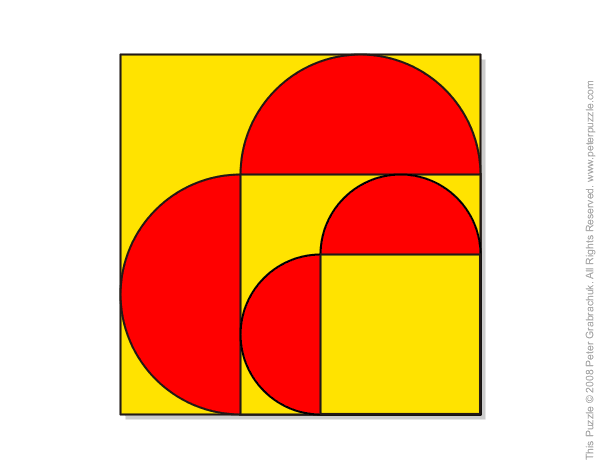
Double Hearts Ratio - Solution

Which area is bigger: the total orange or the total red?


The Solution . . .

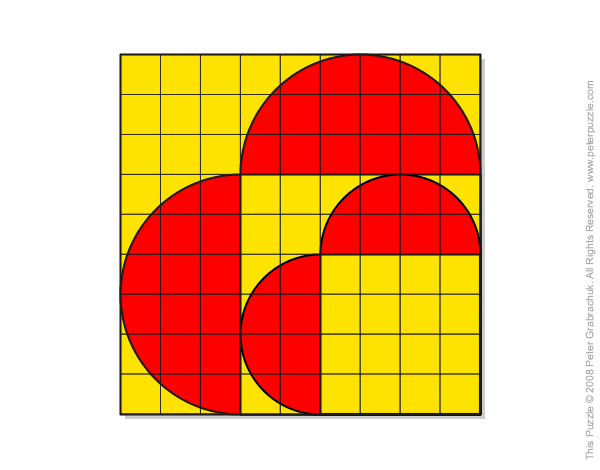
Using the illustration below, we can calculate the following areas:

A(square) = 9 x 9 = 81;
A(red) = 28.27 + 12.57 = 40.84;
A(orange) = 81 - 40.84 = 40.16.
Thus, A(red) > A(orange).

Diophantus - Solution

We know very little about the life of the mathematician Diophantus (often known as the 'father of algebra') except that he came from Alexandria and he lived around the year 250 AD. 

However, there remains a riddle that describes the spans of Diophantus's life:

"This tomb hold Diophantus. Ah, what a marvel! And the tomb tells scientifically the measure of his life. God vouchsafed that he should be a boy for the sixth part of his life; when a twelfth was added, his cheeks acquired a beard; He kindled for him the light of marriage after a seventh, and in the fifth year after his marriage He granted him a son. Alas! late-begotten and miserable child, when he had reached the measure of half his father's life, the chill grave took him. After consoling his grief by this science of numbers for four years, he reached the end of his life."

In simpler English it says: Diophantus's youth lasted 1/6 of his life. He had the first beard in the next 1/12 of his life. At the end of the following 1/7 of his life Diophantus got married. Five years from then his son was born. His son lived exactly 1/2 of Diophantus's life. Diophantus died 4 years after the death of his son.

How long did Diophantus live?

The Solution . . .

There is an equation to reflect the several ages of Diophantus:

1/6x + 1/12x + 1/7x + 5 + 1/2x + 4 = x

So the solution (x) is 84 years.

Cut to the Average Puzzle - Solution

You have two straight lengths of wood. 

How can you cut one of them so that one of the three pieces is the average length of the other two.

Our Solution:

Put the two pieces end to end in a straight line:


Then the average length of the three cut pieces has to be one third of this total length.
So we simply cut one third of the way along the longer piece

Con Fusing - Solution

In front of you are several long fuses. You know they burn for exactly one hour after you light them at one end. The entire fuse does not necessarily burn at a constant speed. For example, it might take five minutes to burn through half the fuse and fifty-five minutes to burn the other half. 

With your lighter and using these fuses, how can you measure exactly three-quarters of an hour of time?

The Solution . . .

Fold one fuse and put another fuse next to it, light all three ends. When the fuse with both ends lit goes out, immediately light the other end of the lit fuse and lite a new fuse. When the second fuse goes out you will have three-quarters of an hour left burning on the third fuse.

Clock in the Mirror - Solution

Joey leaves his house in the morning to go to day camp. 

Just as he is leaving his house he looks at an analog clock reflected in the mirror. 

There are no numbers on the clock, so Joey makes an error in reading the time since it is a mirror image. Joey assumes there is something wrong with the clock and rides his bike to day camp. 

He gets there in 20 minutes and finds that just as he gets there the day camp clock has a time that is 2 1/2 hours (2 hours and 30 minutes) later than the time that he saw in the mirror image of his clock at home. 

What time was it when he got to day camp?

(The clock at camp and the clock at home were both set to the correct time.)

The Solution . . .

First subtract 20 minutes from 2 1/2 hours to compensate for his 20 minute bike ride to give a difference of 2 hours and 10 minutes.

To be a "Mirror Effect" it must be mirrored around 12 o'clock (when the hands are straight up), or around 6 o'clock (when the hands are pointing up and down), as we know he left in the morning, it must be 6 o'clock.

So, divide that 2 hours and 10 minutes by 2 and this will give you the center-point (65 minutes) for compensating for the mirror. 

By adding that 65 minutes to 6 o'clock you get the time he left home (7:05), and the time he saw in the mirror (4:55). 

Furthermore, by re-adding the 20 minutes from when he left (7:05), you get what time he got to camp (7:25).

Chain Reaction Puzzle - Solution

Chains. Make-up. What's the connection? The answer lies in a film. The DIY chain of shops, TEXAS, once made a film about their new eye make-up. They called it "The Texas Chain Store Mascara". I digress.

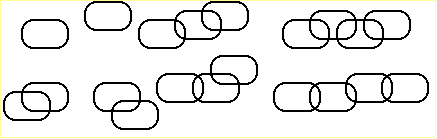
Below you can see several bits of broken chain. I have been told to join up all the pieces to make a complete necklace using all twenty links.


However, it is a very fiddly job, and it takes one minute to cut one link, and two minutes to join it up again. How long will it take me to finish the necklace?

Our Solution:

Just 15 minutes!! That's a surprise, isn't it? I'm sure you're on the very edge of your seat to know how it's done.

I'll tell you anyway.

Separate the two shortest lengths of chain by two cuts. This makes two open links and four single closed ones.
Time taken: 2 minutes. 
Cut open three of the single links. This leaves five open links and five pieces of chain (4, 4, 3, 3, 1).
Time taken: 3 minutes. 
Use the five open links to join the five pieces of chain (each link joins two ends).
Time taken: 10 minutes. 

TOTAL TIME: 15 MINUTES.

Broken Stick Puzzle - Solution

A 1-metre stick is broken into two pieces at random. What is the length of the shorter piece, on average?

Our Solution:

The shorter piece will be randomly from 0cm to 50cm long, with an average of 25cm

A Hole New Board Game Puzzle - Solution

How can I cut the board into only two pieces so that they will fill the hole exactly?


Our Solution: