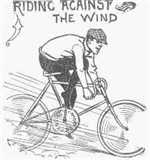
 The Puzzle: A bicycle rider went a mile in three minutes with the wind, and returned in four minutes against the wind. How fast could he ride a mile if there was no wind? The Puzzle: A bicycle rider went a mile in three minutes with the wind, and returned in four minutes against the wind. How fast could he ride a mile if there was no wind?Solution:Contrary to the popular answer to problems of this kind, that if a rider goes a mile in three minutes with the wind, and returns against the wind in four minutes, that 3 and 4 equal 7, should give a correct average, so that his time should be taken to be 3 and a half minutes. We find this answer to be incorrect, because the wind has helped him for only three minutes, while it has worked adversely for four minutes. If he could ride a mile in three minutes with the wind, it is clear that he could go a mile and a third in four minutes, and one mile in four minutes against the wind. Therefore two and one-third miles in eight minutes gives his actual speed, because the wind helped him just as much as it has retarded him, so his actual speed for a single mile without any wind would be 3 minutes and 25 and 5/7 seconds. |
Sunday, 21 July 2013
Riding Against the Wind - Solution

Puzzling Prattle - Solution
The Puzzle: Two school children, who were all tangled up in their reckoning of the days of the week, paused to straighten matters out over a circus poster, when little Priscilla, who was hinting for an invitation to the show, remarked to John; "When the day after tomorrow is yesterday, "today" will be as far from Sunday as that day was which was "today" when the day before yesterday was "tomorrow"!
On what day of the week did this puzzling prattle occur?
Solution:
It is evident that the children were so befogged over the calendar that they had started to school with their books on Sunday morning! For it is plain that when the day after tomorrow is yesterday, today will be three days hence, just as when the day before yesterday was tomorrow carries us back three days from now, which must be Sunday, to be midway between the two "todays".
On what day of the week did this puzzling prattle occur?
Solution:
It is evident that the children were so befogged over the calendar that they had started to school with their books on Sunday morning! For it is plain that when the day after tomorrow is yesterday, today will be three days hence, just as when the day before yesterday was tomorrow carries us back three days from now, which must be Sunday, to be midway between the two "todays".
Outwitting the Weighing Machine - Solution
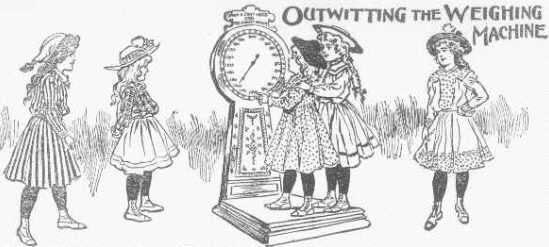 The Puzzle: The five school children in couples weigh 129 pounds, 125 pounds, 124 pounds, 123 pounds, 122 pounds, 121 pounds, 120 pound, 118 pounds, 116 pounds and 114 pounds on a weighing machine. What was the weight of each one of the five little girls if taken separately? The Puzzle: The five school children in couples weigh 129 pounds, 125 pounds, 124 pounds, 123 pounds, 122 pounds, 121 pounds, 120 pound, 118 pounds, 116 pounds and 114 pounds on a weighing machine. What was the weight of each one of the five little girls if taken separately?Solution:Let e > d > c > b > a be the girls weights. NB no two girls have the same weights, otherwise there would have been duplicate weighings. e+d must be the heaviest and e+c the second heaviest weighing. a+b must be the lightest and a+c the second lightest weighing. It might be the a+d or b+c could be next, fortunately we don't need to know. The sum of the weighings is 1212 and each girl is weighed four times => a+b+c+d+e = 1212/4 = 303 c = (a+b+c+d+e) - (a+b) - (d+e) = 303 - 114 - 129 = 60 a+c = 116 => a = 116 - 60 = 56 a+b = 114 => b = 114 - 56 = 58 c+e = 125 => e = 125 - 60 = 65 e+d = 129 => d = 129 - 65 = 64 So the girls weights are: 56, 58, 60, 64 and 65. |
Our Columbus Problem - Solution
The Puzzle: Here is a famous prize problem that Sam Loyd issued in 1882, offering $1000 as a prize for the best answer showing how to arrange the seven figures and the eight "dots" .4.5.6.7.8.9.0. which would add up to 82.
Out of several million answers, only two were found to be correct.
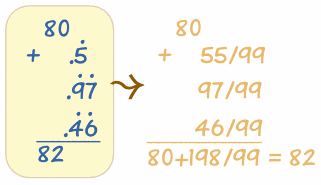
The dot over a number signifies that it is a repeater which would go on for ever, as when we endeavor to describe 1/3 decimally as 0.33333 . . . . (etc)
With a series of numbers we place the dot over the first and last, as with 0.97979797979 . . . (etc)
The remarkable feature being that a proper fraction divided by 9s e.g. 46/99 is exactly equal to the numerator with the repeater sign followed by the decimal.
Out of several million answers, only two were found to be correct.
The Solution . . .
The dot over a number signifies that it is a repeater which would go on for ever, as when we endeavor to describe 1/3 decimally as 0.33333 . . . . (etc)
With a series of numbers we place the dot over the first and last, as with 0.97979797979 . . . (etc)
The remarkable feature being that a proper fraction divided by 9s e.g. 46/99 is exactly equal to the numerator with the repeater sign followed by the decimal.
Merry Go Round Puzzle - Solution
The Puzzle: While enjoying a giddy ride at the carousel Sammy propounded a puzzle which reflects much credit to his mental abilities.
"One third of the number of kids riding ahead of me, added to three-quarter of those riding behind me gives the correct number of children on this Merry-Go-Round" is the way he puts it; but it will puzzle you quite a little to tell just how many riders there were at this whirling circus.
Solution:
There must have been a multiple of 3 as well as 4 plus one children.
So, the minimum number of children riding on this Merry-Go-Round could be thirteen.
Those who rode ahead of Sammy at the same time came behind him.
If there were twelve, we simply add three-quarter of twelve to one-third of twelve, which gives thirteen, the total number including Sammy himself.
"One third of the number of kids riding ahead of me, added to three-quarter of those riding behind me gives the correct number of children on this Merry-Go-Round" is the way he puts it; but it will puzzle you quite a little to tell just how many riders there were at this whirling circus.
Solution:
There must have been a multiple of 3 as well as 4 plus one children.
So, the minimum number of children riding on this Merry-Go-Round could be thirteen.
Those who rode ahead of Sammy at the same time came behind him.
If there were twelve, we simply add three-quarter of twelve to one-third of twelve, which gives thirteen, the total number including Sammy himself.
Marther's Vineyard Puzzle - Solution
What are the maximum number of grape vines that can be planted, not closer than nine feet apart, in a square plot containing one-sixteenth of an acre?
(Note: each side of this square plot would be 52 feet 2 inches)
(Note: each side of this square plot would be 52 feet 2 inches)
Our Solution:
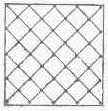
By drawing a line on the bias as shown in the adjoining diagram, from one corner to another, and crossing and paralleling the same, it will be found that 41 vines can be planted, a little over nine feet apart, and well within the fence line.
HOWEVER, Peter Noll has found a better solution: 44 grape trees
This comes about by planting 6,5,6,5,6,5,6,5 trees in 8 layers with horizontal spacing 10.433 feet and layer distances 7.45 feet. Any 3 adjacent trees form a triangle with side lengths 10.433, 9.097, 9.097 feet.

HOWEVER, Peter Noll has found a better solution: 44 grape trees
This comes about by planting 6,5,6,5,6,5,6,5 trees in 8 layers with horizontal spacing 10.433 feet and layer distances 7.45 feet. Any 3 adjacent trees form a triangle with side lengths 10.433, 9.097, 9.097 feet.
Guess the Boy's Age Puzzle - Solution
It appears that an ingenious or eccentric teacher being desirous of bringing together a number of older pupils into a class he was forming, offered to give a prize each day to the side of boys or girls whose combined ages would prove to be the greatest.
Well, on the first day there was only one boy and one girl in attendance, and, as the boy's age was just twice that of the girl's, the first day's prize went to the boy.
The next day the girl brought her sister to school, and it was found that their combined ages were just twice that of the boy, so the two girls divided the prize.
When school opened the next day, however, the boy had recruited one of his brothers, and it was found that the combined ages of the two boys were exactly twice as much as the ages of the two girls, so the boys carried off the honors of that day and divided the prizes between them.
The battle waxed warm and on the fourth day the two girls appeared accompanied by their elder sister; so it was then the combined ages of the three girls against the two boys, and the girls won off course, once more bringing their ages up to just twice that of the boys'. The struggle went on until the class was filled up, but as our problem does not need to go further than this point, to tell the age of that first boy, provided that the last young lady joined the class on her twenty-first birthday. Now, guess the first boy's age.
Solution:
Answer: 1,276 days. This puzzle can easily be solved by the "trial method". The first girl was just 638 days old, and the boy twice as much, namely 1,276 days. The next day the youngest girl will be 639 days old, and her new recruit 1,915 days, total, 2,554 days, which doubles that of the first boy, who having gained one day, will be 1,277 days old. The next day the boy, being 1,278 days old, brings his big brother, who is 3,834 days old, so their combined ages amount to 5,112 days, which is just twice the ages of the girls, who will now be 640 and 1,916, or 2,556.
The next day, the girls gaining one day each, will represent 2,558 days, which added to 7,670 days of the last recruit, brings up their sum total to 10,228 days, which is just twice that of the two boys, which, with the two points added for the last day, would be increased to 5,114 days.
We arrive at the 7,670 days by saying, the young lady having reached her twenty-first birthday, 21 times 365 equals 7,665 plus 4 days for four leap years, and the extra one day, which, comes with the twenty-first birthday (which is one day towards the twenty-second year).
AN APPROXIMATE SOLUTION USING ALGEBRA
This solution ignores the day joined, so will be a few days wrong.
Let us use x=boy 1's age, y=boy 2's age, p=girl 1's age, q=girl 2's age, and we know that girl 3 is 21
When the 3rd girl joined: 2(x+y)=p+q+21
We also know that p+q=4p, as when the 2nd girl joined the girl ages went from half to double. So: 2(x+y)=4p+21
x+y=2p+10.5 (halve both sides)
x+y=x+10.5 (because 2p=x)
y=10.5 (subtract x from both sides)
y=3x, so: x=3.5 years old (about 1,278 days)
ANOTHER (SIMPLER) SOLUTION USING ALGEBRA
Let the first girl be x, the first boy is 2x, the second girl is 3x (since x plus 3x = 4x twice the first boys age) boy three is 6x (6x + 2x = 8x twice girl 1 and 2 ages) and the third girl is 12x (twice boy one and two). Therefore 21 = 12x, 21/12 is 1.75 making the first boys age 3.5 years.
Well, on the first day there was only one boy and one girl in attendance, and, as the boy's age was just twice that of the girl's, the first day's prize went to the boy.
The next day the girl brought her sister to school, and it was found that their combined ages were just twice that of the boy, so the two girls divided the prize.
When school opened the next day, however, the boy had recruited one of his brothers, and it was found that the combined ages of the two boys were exactly twice as much as the ages of the two girls, so the boys carried off the honors of that day and divided the prizes between them.
The battle waxed warm and on the fourth day the two girls appeared accompanied by their elder sister; so it was then the combined ages of the three girls against the two boys, and the girls won off course, once more bringing their ages up to just twice that of the boys'. The struggle went on until the class was filled up, but as our problem does not need to go further than this point, to tell the age of that first boy, provided that the last young lady joined the class on her twenty-first birthday. Now, guess the first boy's age.
Solution:
Answer: 1,276 days. This puzzle can easily be solved by the "trial method". The first girl was just 638 days old, and the boy twice as much, namely 1,276 days. The next day the youngest girl will be 639 days old, and her new recruit 1,915 days, total, 2,554 days, which doubles that of the first boy, who having gained one day, will be 1,277 days old. The next day the boy, being 1,278 days old, brings his big brother, who is 3,834 days old, so their combined ages amount to 5,112 days, which is just twice the ages of the girls, who will now be 640 and 1,916, or 2,556.
The next day, the girls gaining one day each, will represent 2,558 days, which added to 7,670 days of the last recruit, brings up their sum total to 10,228 days, which is just twice that of the two boys, which, with the two points added for the last day, would be increased to 5,114 days.
We arrive at the 7,670 days by saying, the young lady having reached her twenty-first birthday, 21 times 365 equals 7,665 plus 4 days for four leap years, and the extra one day, which, comes with the twenty-first birthday (which is one day towards the twenty-second year).
AN APPROXIMATE SOLUTION USING ALGEBRA
This solution ignores the day joined, so will be a few days wrong.
Let us use x=boy 1's age, y=boy 2's age, p=girl 1's age, q=girl 2's age, and we know that girl 3 is 21
When the 3rd girl joined: 2(x+y)=p+q+21
We also know that p+q=4p, as when the 2nd girl joined the girl ages went from half to double. So: 2(x+y)=4p+21
x+y=2p+10.5 (halve both sides)
x+y=x+10.5 (because 2p=x)
y=10.5 (subtract x from both sides)
y=3x, so: x=3.5 years old (about 1,278 days)
ANOTHER (SIMPLER) SOLUTION USING ALGEBRA
Let the first girl be x, the first boy is 2x, the second girl is 3x (since x plus 3x = 4x twice the first boys age) boy three is 6x (6x + 2x = 8x twice girl 1 and 2 ages) and the third girl is 12x (twice boy one and two). Therefore 21 = 12x, 21/12 is 1.75 making the first boys age 3.5 years.
Great Picnic Puzzle Puzzle - Solution
When they started off on the great annual picnic every wagon in town was pressed into service.
Half way to the picnic ground ten wagons broke down, so it was necessary for each of the remaining wagons to carry one more person.
When they started for home it was discovered that fifteen more wagons were out of commission, so on the return trip there were three persons more in each wagon than when they started out in the morning.
Now who can tell how many people attended the great annual picnic?
Solution:
There must have been 900 picnickers who would be seated 9 to a wagon if there were 100 vehicles, or 10 to a wagon after 10 of the wagons had broken.
When they started for home with 75 wagons, it was necessary for 12 persons to ride in each wagon (3 more than the 9 per wagon in the morning).
Half way to the picnic ground ten wagons broke down, so it was necessary for each of the remaining wagons to carry one more person.
When they started for home it was discovered that fifteen more wagons were out of commission, so on the return trip there were three persons more in each wagon than when they started out in the morning.
Now who can tell how many people attended the great annual picnic?
Solution:
There must have been 900 picnickers who would be seated 9 to a wagon if there were 100 vehicles, or 10 to a wagon after 10 of the wagons had broken.
When they started for home with 75 wagons, it was necessary for 12 persons to ride in each wagon (3 more than the 9 per wagon in the morning).
Covent Garden Problem - Solution
The Puzzle: Here is a puzzle known as the Covent Garden Problem, which appeared in London half a century ago, accompanied by the somewhat surprising assertion that it had mystified the best mathematicians of England:
Mrs. Smith and Mrs. Jones had equal number of apples but Mrs. Jones had larger fruits and was selling hers at the rate of two for a penny, while Mrs. Smith sold three of hers for a penny.
Mrs. Smith was for some reason called away and asked Mrs. Jones to dispose of her stock. Upon accepting the responsibility of disposing her friend's stock, Mrs. Jones mixed them together and sold them of at the rate of five apples for two pence.
When Mrs. Smith returned the next day the apples had all been disposed of, but when they came to divide the proceeds they found that they were just seven pence short, and it is this shortage in the apple or financial market which has disturbed the mathematical equilibrium for such a long period.
Supposing that they divided the money equally, each taking one-half, the problem is to tell just how much money Mrs. Jones lost by the unfortunate partnership?
Solution:
The mixed apples were sold of at the rate of five apples for two pence. So they must have had a multiple of five i.e. 5, 10, 15, 20, 25, 30,…, 60, 65,… etc apples.
But the minimum number of apples they could have together is 60; so that 30 would have been of Mrs. Smith's that would fetch her 10 (an integer) pence and the other 30 of Mrs. Jones's that would fetch her 15 (also an integer) pence.
When sold separately it would fetch them 10+15=25 pence altogether. But when sold together it would fetch them 60X2/5=24 pence i.e. a loss of one (25-24=1) pence.
Since they lost 7 pence altogether; they had altogether 60X7=420 apples that fetched them only 420X2/5=168 pence and they shared 84 pence each of them. But Mrs. Jones could sell her 420/2=210 apples for 210/2=105 pence so she lost "21 pence".
Note: to solve it algebraically:
They lost 7 pence altogether
Suppose each lady has x apples
x/2 + x/3 - 2(2x/5) = 7
15x + 10x - 24x = 210
x = 210
Note: Mrs. Johns lost 21 pence.
But without working Mrs. Smith earned 14 extra pence!
(84 pence – 210/3 pence = 14 pence).
Not very fair!
(Perhaps Mrs. Johns was not very good at math)
Mrs. Smith and Mrs. Jones had equal number of apples but Mrs. Jones had larger fruits and was selling hers at the rate of two for a penny, while Mrs. Smith sold three of hers for a penny.
Mrs. Smith was for some reason called away and asked Mrs. Jones to dispose of her stock. Upon accepting the responsibility of disposing her friend's stock, Mrs. Jones mixed them together and sold them of at the rate of five apples for two pence.
When Mrs. Smith returned the next day the apples had all been disposed of, but when they came to divide the proceeds they found that they were just seven pence short, and it is this shortage in the apple or financial market which has disturbed the mathematical equilibrium for such a long period.
Supposing that they divided the money equally, each taking one-half, the problem is to tell just how much money Mrs. Jones lost by the unfortunate partnership?
Solution:
The mixed apples were sold of at the rate of five apples for two pence. So they must have had a multiple of five i.e. 5, 10, 15, 20, 25, 30,…, 60, 65,… etc apples.
But the minimum number of apples they could have together is 60; so that 30 would have been of Mrs. Smith's that would fetch her 10 (an integer) pence and the other 30 of Mrs. Jones's that would fetch her 15 (also an integer) pence.
When sold separately it would fetch them 10+15=25 pence altogether. But when sold together it would fetch them 60X2/5=24 pence i.e. a loss of one (25-24=1) pence.
Since they lost 7 pence altogether; they had altogether 60X7=420 apples that fetched them only 420X2/5=168 pence and they shared 84 pence each of them. But Mrs. Jones could sell her 420/2=210 apples for 210/2=105 pence so she lost "21 pence".
Note: to solve it algebraically:
They lost 7 pence altogether
Suppose each lady has x apples
x/2 + x/3 - 2(2x/5) = 7
15x + 10x - 24x = 210
x = 210
Note: Mrs. Johns lost 21 pence.
But without working Mrs. Smith earned 14 extra pence!
(84 pence – 210/3 pence = 14 pence).
Not very fair!
(Perhaps Mrs. Johns was not very good at math)
A Question of Time Puzzle - Solution
The Puzzle:
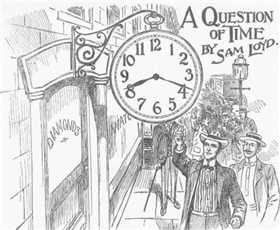
The hour and minute hands are at equal distance from the 6 hour, what time will it be exactly?
Our Solution:
Say answer is "8 hour X minute". According as proposition, the angle between the minute hand and "mark 4" of the watch is equal to the angle between the hour hand and "mark 8" of the watch.
We know in 60 minutes the minute hand makes 360 degrees (360/60=6 degrees per minute) and the hour hand makes 360/12=30 degrees (30/60=1/2 degrees per minute).
Therefore, (20-X) minutes corresponds to 6(20-X) degrees (this is the angle between the minute hand and "mark 4").
And in X minutes the hour hand makes X/2 degrees with "mark 8".
Thus, X/2=6(20-X) gives X=18 minutes 27 and 9/13 second.
So, the answer is 8 hour, 18 minutes, 27 9/13 second.
We know in 60 minutes the minute hand makes 360 degrees (360/60=6 degrees per minute) and the hour hand makes 360/12=30 degrees (30/60=1/2 degrees per minute).
Therefore, (20-X) minutes corresponds to 6(20-X) degrees (this is the angle between the minute hand and "mark 4").
And in X minutes the hour hand makes X/2 degrees with "mark 8".
Thus, X/2=6(20-X) gives X=18 minutes 27 and 9/13 second.
So, the answer is 8 hour, 18 minutes, 27 9/13 second.
Who Squares Wins Puzzle - Solution
The Puzzle:
The diagram below shows a pattern made up of squares:
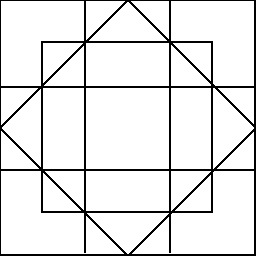
How many squares can be found in the pattern?
How many squares can be found in the pattern?
Our Solution:
There are 24 squares of various sizes, as this breakdown diagram illustrates:

Triplets - Solution
The Puzzle: Three sisters are identical triplets. The oldest by minutes is Sarah, and Sarah always tells anyone the truth. The next oldest is Sue, and Sue always will tell anyone a lie. Sally is the youngest of the three. She sometimes lies and sometimes tells the truth.
Victor, an old friend of the family's, came over one day and as usual he didn't know who was who, so he asked each of them one question.
Victor asked the sister that was sitting on the left, "Which sister is in the middle of you three?" and the answer he received was, "Oh, that's Sarah."
Victor then asked the sister in the middle, "What is your name?" The response given was, "I'm Sally."
Victor turned to the sister on the right, then asked, "Who is that in the middle?" The sister then replied, "She is Sue."
This confused Victor; he had asked the same question three times and received three different answers.
Who was who?
Victor, an old friend of the family's, came over one day and as usual he didn't know who was who, so he asked each of them one question.
Victor asked the sister that was sitting on the left, "Which sister is in the middle of you three?" and the answer he received was, "Oh, that's Sarah."
Victor then asked the sister in the middle, "What is your name?" The response given was, "I'm Sally."
Victor turned to the sister on the right, then asked, "Who is that in the middle?" The sister then replied, "She is Sue."
This confused Victor; he had asked the same question three times and received three different answers.
Who was who?
The Solution . . .
The first one cannot be Sarah, because that would make the first one a liar. The second one cannot be Sarah for the same reason. So, the third sister must be Sarah. This means the middle one is Sue and the only one left is Sally.
Touching Marbles Puzzle - Solution
The Puzzle:
Arrange these six marbles so that each one touches all four marbles of a different colour.

Our Solution:
The six marbles have to be arranged as vertices of an octahedron:

Three Of The Best Puzzle - Solution
The Puzzle:
Professor Frantic set these three problems to her class of maniacs at Clueless University.
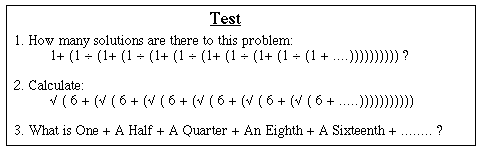
Three replies are given below:
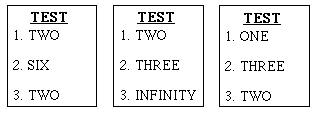
If everybody got one question wrong, what are the correct answers to Professor Frantic's questions?
Three replies are given below:
If everybody got one question wrong, what are the correct answers to Professor Frantic's questions?
Our Solution:
It may seem obvious, but if everybody got one question wrong, then everybody got two questions right! Have another look at the answers:
If the first person got Question 1 wrong, then so did the second person.
That gives two completely different sets of "correct" answers for Question 2 and Question 3!
So Person 1 Question 1 must be right: "TWO".
The same working gives the other answers.
So Q1 TWO, Q2 THREE, Q3 TWO are the correct answers.
If the first person got Question 1 wrong, then so did the second person.
That gives two completely different sets of "correct" answers for Question 2 and Question 3!
So Person 1 Question 1 must be right: "TWO".
The same working gives the other answers.
So Q1 TWO, Q2 THREE, Q3 TWO are the correct answers.
Three Hats Puzzle - Solution
Three people enter a room and have a green or blue hat placed on their head. They cannot see their own hat, but can see the other hats.
The color of each hat is purely random. All hats could be green, or blue, or 1 blue and 2 green, or 2 blue and 1 green.
They need to guess their own hat color by writing it on a piece of paper, or they can write "pass".
They cannot communicate with each other in any way once the game starts. But they can have a strategy meeting before the game.
If at least one of them guesses correctly they win $50,000 each, but if anyone guess incorrectly they all get nothing.
What strategy would give the best chance of success?
(Hint: 100% chance of success is not possible.)
The color of each hat is purely random. All hats could be green, or blue, or 1 blue and 2 green, or 2 blue and 1 green.
They need to guess their own hat color by writing it on a piece of paper, or they can write "pass".
They cannot communicate with each other in any way once the game starts. But they can have a strategy meeting before the game.
If at least one of them guesses correctly they win $50,000 each, but if anyone guess incorrectly they all get nothing.
What strategy would give the best chance of success?
(Hint: 100% chance of success is not possible.)
Our Solution:
Simple strategy: Elect one person to be the guesser, the other two pass. The guesser chooses randomly "green" or "blue". This gives them a 50% chance of winning.
Better strategy: If you see two blue or two green hats, then write down the opposite color, otherwise write down "pass".
It works like this ("-" means "pass"):
Hats: GGG, Guess: BBB, Result: Lose
Hats: GGB, Guess: --B, Result: Win
Hats: GBG, Guess: -B-, Result: Win
Hats: GBB, Guess: G--, Result: Win
Hats: BGG, Guess: B--, Result: Win
Hats: BGB, Guess: -G-, Result: Win
Hats: BBG, Guess: --G, Result: Win
Hats: BBB, Guess: GGG, Result: Lose
Result: 75% chance of winning!
Better strategy: If you see two blue or two green hats, then write down the opposite color, otherwise write down "pass".
It works like this ("-" means "pass"):
Hats: GGG, Guess: BBB, Result: Lose
Hats: GGB, Guess: --B, Result: Win
Hats: GBG, Guess: -B-, Result: Win
Hats: GBB, Guess: G--, Result: Win
Hats: BGG, Guess: B--, Result: Win
Hats: BGB, Guess: -G-, Result: Win
Hats: BBG, Guess: --G, Result: Win
Hats: BBB, Guess: GGG, Result: Lose
Result: 75% chance of winning!
Three Coaches, Three Athletes and a River - Solution
The Puzzle: There are three Athletes (Alex, Brook and Chris) and their individual Coaches (Murphy, Newlyn and Oakley) standing on the shore.
No Coach trusts their Athlete to be near any other Coach unless they are also with them.
There is a boat that can hold a maximum of two persons.
How can the six people get across the river?
No Coach trusts their Athlete to be near any other Coach unless they are also with them.
There is a boat that can hold a maximum of two persons.
How can the six people get across the river?
The Solution . . .
Alex and Brook cross, Alex returns
Alex and Chris cross, Chris returns
Coaches Murphy and Newlyn cross to join their Athletes
Brook and Newlyn return
Newlyn and Oakley cross, Alex returns
* All three Coaches are across
Alex and Brook cross, Coach Oakley returns
Chris and Coach Oakley cross.
DONE!
Three Choices with One Coin Puzzle - Solution
At a restaurant, how could you choose one out of three desserts with equal probability with the help of a coin?
Bonus: What if the coin is biased and the bias is unknown?
Bonus: What if the coin is biased and the bias is unknown?
Our Solution:
Toss the coin twice.
Let TH, HT and TT correspond to the three choices.
And if you get HH, just repeat (so it takes 8/3 tosses on average).
BIASED COIN
If the coin was biased, TH and HT would occur with equal probability.
So you could assign THHT, HTTH and THTH to the three choices, with other 4-toss outcomes rejected.
Or you could assign HTT, THT and TTH to the three choices, with other 3-toss outcomes rejected.
Three Boxes with Two Balls Each - Solution
The Puzzle: The first box has two white balls. The second box has two black balls. The third box has a white and a black ball.
Boxes are labeled but all labels are wrong!
You are allowed to open one box, pick one ball at random, see its color and put it back into the box, without seeing the color of the other ball.
How many such operations are necessary to correctly label the boxes?
Solution:
Just One!
Because we know all labels are wrong.
So the BW box must be either BB or WW. Selecting one ball from BW will let you know which.
And the other two boxes can then be worked out logically.
Boxes are labeled but all labels are wrong!
You are allowed to open one box, pick one ball at random, see its color and put it back into the box, without seeing the color of the other ball.
How many such operations are necessary to correctly label the boxes?
Solution:
Just One!
Because we know all labels are wrong.
So the BW box must be either BB or WW. Selecting one ball from BW will let you know which.
And the other two boxes can then be worked out logically.
The Schoolgirl Problem Puzzle - Solution
The Puzzle:
In a boarding school there are fifteen schoolgirls who always take their daily walks in groups of three.
How can it be arranged so that each schoolgirl walks in a group with two different companions every day for a week (7 days)?
Our Solution:
Give the girls letters A to O - the schedule is then:
The famouse Schoolgirls Problem was first posed by Reverend Thomas Kirkman in 1857. It led to a new branch of mathematics called Combinatorics.
The problem has since been described as a specific example of a Steiner Triple System. Numerous methods of solution exist, but Trial and Error still (just!) works, but you must be patient!
Sun Mon Tue Wed Thu Fri Sat
ABC ADE AFG AHI AJK ALM ANO
DHL BIK BHJ BEG CDF BEF BDG
EJN CMO CLN CMN BLO CIJ CHK
FIO FHN DIM DJO EHM DKN EIL
GKM GJL EKO FKL GIN GHO FJM
The famouse Schoolgirls Problem was first posed by Reverend Thomas Kirkman in 1857. It led to a new branch of mathematics called Combinatorics.
The problem has since been described as a specific example of a Steiner Triple System. Numerous methods of solution exist, but Trial and Error still (just!) works, but you must be patient!
The Collapsing Bridge Puzzle - Solution
The Puzzle:
A bridge will collapse in 17 minutes.
4 people want to cross it before it will collapse. It is a dark night and there is only one torch between them.
Only two people can cross at a time.
"A" takes a minute to cross.
"B" takes 2 minutes.
"C" takes 5
and "D" takes 10 minutes
How do they all cross before the bridge collapses?
Only two people can cross at a time.
"A" takes a minute to cross.
"B" takes 2 minutes.
"C" takes 5
and "D" takes 10 minutes
How do they all cross before the bridge collapses?
Our Solution:
A and B cross first using up 2 minutes.
A comes back making it 3
C and D cross making it 13 minutes
then B crosses back over making it 15 minutes.
And finally A and B cross together to make it 17 minutes!
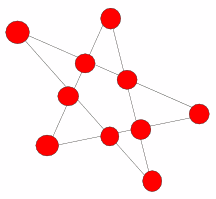
Ten Balls in Five Lines - Solution
The Puzzle: Place 10 balls in 5 lines in such a way that each line has exactly 4 balls on it.
The Solution . . .
 |
Shirt Friends - Solution
The Puzzle: At a restaurant downtown, Mr. Red, Mr. Blue, and Mr. White meet for lunch. Under their coats
they are wearing either a red, blue, or white shirt.
Mr. Blue says, "Hey, did you notice we are all wearing different colored shirts from our names?" The man
wearing the white shirt says, "Wow, Mr. Blue, that's right!"
Can you tell who is wearing what color shirt?
The Solution:
Mr. Blue could only be wearing white or red and we know that there is already someone else wearing the white shirt so Mr. Blue could only be wearing the red shirt.
Mr. White could have only been wearing a blue or a red shirt, and red is already taken, so Mr. White is wearing a blue shirt.
Mr. Red now has to be wearing a white shirt.
they are wearing either a red, blue, or white shirt.
Mr. Blue says, "Hey, did you notice we are all wearing different colored shirts from our names?" The man
wearing the white shirt says, "Wow, Mr. Blue, that's right!"
Can you tell who is wearing what color shirt?
The Solution:
Mr. Blue could only be wearing white or red and we know that there is already someone else wearing the white shirt so Mr. Blue could only be wearing the red shirt.
Mr. White could have only been wearing a blue or a red shirt, and red is already taken, so Mr. White is wearing a blue shirt.
Mr. Red now has to be wearing a white shirt.
Subscribe to:
Posts (Atom)