Sunday, 11 August 2013

5 Pirates Puzzle - Solution


The Puzzle:

5 pirates of different ages have a treasure of 100 gold coins.

On their ship, they decide to split the coins using this scheme:

The oldest pirate proposes how to share the coins, and ALL pirates (including the oldest) vote for or against it.

If 50% or more of the pirates vote for it, then the coins will be shared that way. Otherwise, the pirate proposing the scheme will be thrown overboard, and the process is repeated with the pirates that remain.

As pirates tend to be a bloodthirsty bunch, if a pirate would get the same number of coins if he voted for or against a proposal, he will vote against so that the pirate who proposed the plan will be thrown overboard.

Assuming that all 5 pirates are intelligent, rational, greedy, and do not wish to die, (and are rather good at math for pirates) what will happen?


Our Solution:

The oldest pirate will propose a 98 : 0 : 1 : 0 : 1 split, in other words the oldest pirate gets 98 coins, the middle pirate gets 1 coin and the youngest gets 1 coin.

Let us name the pirates (from oldest to youngest): Alex, Billy, Colin, Duncan and Eddie.

Working backwards:

2 Pirates: Duncan splits the coins 100 : 0 (giving himself all the gold). His vote (50%) is enough to ensure the deal.

3 Pirates: Colin splits the coins 99 : 0 : 1. Eddie will accept this deal (getting just 1 coin), because he knows that if he rejects the deal there will be only two pirates left, and he gets nothing.

4 Pirates: Billy splits the coins 99 : 0 : 1 : 0. By the same reasoning as before, Duncan will support this deal. Billy would not waste a spare coin on Colin, because Colin knows that if he rejects the proposal, he will pocket 99 coins once Billy is thrown overboard. Billy would also not give a coin to Eddie, because Eddie knows that if he rejects the proposal, he will receive a coin from Colin in the next round anyway.

5 Pirates: Alex splits the coins 98 : 0 : 1 : 0 : 1. By offering a gold coin to Colin (who would otherwise get nothing) he is assured of a deal.

(Note: In the final deal Alex would not give a coin to Billy, who knows he can pocket 99 coins if he votes against Alex's proposal and Alex goes overboard. Likewise, Alex would not give a coin to Duncan, because Duncan knows that if he votes against the proposal, Alex will be voted overboard and Billy will propose to offer Duncan the same single coin as Alex. All else equal, Duncan would rather see Alex go overboard and collect his one coin from Billy.)

5 Pirates Version 2 Puzzle - Solution


The Puzzle:

5 pirates of different ages have a treasure of 100 gold coins.

On their ship, they decide to split the coins using this scheme:

The oldest pirate proposes how to share the coins, the OTHER pirates (not including the oldest) will vote for or against it.

If 50% or more of the pirates vote for it, then the coins will be shared that way. Otherwise, the pirate proposing the scheme will be thrown overboard, and the process is repeated with the pirates that remain.

Assuming that all 5 pirates are intelligent, rational, greedy, and do not wish to die, (and are rather good at math for pirates) what will happen?


Our Solution:

The oldest pirate will propose a 97 : 0 : 1 : 0 : 2 split.

Let us name the pirates (from oldest to youngest): Alex, Billy, Colin, Duncan and Eddie.

Working backwards:

2 Pirates: Duncan splits the coins 0: 100 (giving all to Eddie). Otherwise, and perhaps even then, Eddie would vote against him and over he goes!

3 Pirates: Colin splits the coins 99 : 1 : 0. Eddie is going to vote against him no matter what (see above) so gets nothing, but Duncan will vote for him, to get at least one gold out of it (if Duncan votes against him, there will only be two pirates remaining and Duncan will get nothing, and may even lose his life!)

4 Pirates: Billy splits the coins 97 : 0 : 2 : 1. This way, Eddie will vote for him, and so will Duncan - they're getting more than they would under 3 pirates.

5 Pirates: Alex splits the coins 97 : 0 : 1 : 0 : 2. This way, Eddie will vote for him, and so will Colin - they're both getting better than they would under 4 pirates.

A Perfect Match Puzzle - Solution


The Puzzle:

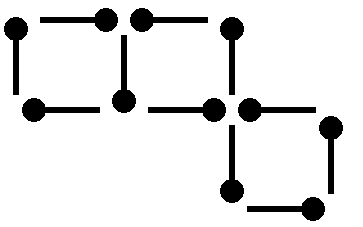
In this diagram 11 matches make 3 squares:


Your challenge is to move 3 matches to show 2 squares.

Our Solution:


Apples and Friends - Solution

The Puzzle: You have a basket containing ten apples. You have ten friends, who each desire an apple. You give each of your friends one apple.

After a few minutes each of your friends has one apple each, yet there is an apple remaining in the basket.

How?


The Solution . . .

You give an apple each to your first nine friends, and a basket with an apple to your tenth friend.

Each friend has an apple, and one of them has it in a basket.

Bags of Marbles - Solution

The Puzzle: 

You have three bags, each containing two marbles. Bag A contains two white marbles, Bag B contains two black marbles, and Bag C contains one white marble and one black marble.

You pick a random bag and take out one marble. 

It is a white marble.

What is the probability that the remaining marble from the same bag is also white?


The Solution . . .

2/3 (not 1/2)

You know that you do not have Bag B (two black marbles) so there are three possibilities

You chose Bag A, first white marble. The other marble will be white
You chose Bag A, second white marble. The other marble will be white
You chose Bag C, the white marble. The other marble will be black

So 2 out of 3 possibilities are white.

Why not 1/2? You are selecting marbles, not bags.

Black and White Hats - Solution

The Puzzle:
 Cannibals ambush a safari in the jungle and capture three men. The cannibals give the men a single chance to escape uneaten. 

The captives are lined up in order of height, and are tied to stakes. The man in the rear can see the backs of his two friends, the man in the middle can see the back the man in front, and the man in front cannot see anyone. The cannibals show the men five hats. Three of the hats are black and two of the hats are white. 

Blindfolds are then placed over each man's eyes and a hat is placed on each man's head. The two hats left over are hidden. The blindfolds are then removed and it is said to the men that if one of them can guess what color hat he is wearing they can all leave unharmed. 

The man in the rear who can see both of his friends' hats but not his own says, "I don't know". The middle man who can see the hat of the man in front, but not his own says, "I don't know". The front man who cannot see ANYBODY'S hat says "I know!" 

How did he know the color of his hat and what color was it?


The Solution . . .

The man in front knew he was wearing a black hat because he knew the first man did not see two white hats and he knew that the second man did not see one white hat because if he saw a white hat, the second man would have known that his hat was black from hearing the first man's statement.

Saturday, 3 August 2013

Measuring 4 and 4 Litres - Solution

You are camping, and have an 8-liter bowl which is full of fresh water.

You need to share this water fairly into exactly two portions (4 + 4 liters).

But you only have two empty bowls: a 5-liter and a 3-liter bowl. 

Divide the 8 liters in half in as short a time as possible.

The Solution . . .

Pour 5 liters from the 8-liter to the 5-liter bowl.

Pour 3 liters from the 5-liter to the 3-liter bowl, then pour those 3 liters back to the 8-liter bowl (the 8-liter bowl now has 6 liters).

Pour the remaining 2 liters from the 5-liter over to the 3-liter bowl, the bowls now contain 6, 0 and 2 liters each.

Now, pour 5 liters from the 8-liter to the 5-liter bowl (the 8-liter bowl now has 1 liter)

Pour from the 5-liter to the 3-liter bowl until it is full (exactly one liter). There should now be 4 liters left in the 5-liter bowl,

Pour the 3 liters from the 3-liter to the 8-liter bowl (and now the 8-liter bowl has 4 liters)

The 8-liter and 5-liter bowls now have 4 liters each, as required. And you will not be accused of bias by your fellow campers!

Measuring 2, 2 and 3 Liters - Solution

You have three bowls: 7, 4 and 3 liters in capacity. 

Only the 7-liter is full. 

Pour the fewest times to have the bowls containing 2, 2 and 3 liters.

The Solution . . .

Fill the 4-liter from the 7-liter bowl.
Fill the 3-liter from the 4-liter bowl.

You will have 3 liters left in the 7-liter,1 liter in the 4-liter and 3 in the 3-liter bowl. (Let us abbreviate that as 3,1,3)

Now pour from the 3-liter to the 7-liter bowl, and then pour the 1 liter left in the 4-liter bowl to the 3-liter bowl. (Now it looks like 6,0,1)

Now fill the 4 from the 7 (Now it looks like 2,4,1) 
Now fill the 3 from the 4 (Now it looks like 2,2,3) 

And you are done: 2, 2 and 3 liters !

Measuring 2 Litres - Solution

Measure exactly 2 liters of water if you have:

1) 4 and 5-liter bowls
2) 4 and 3-liter bowls

The Solution . . .

1) Fill the 5-liter bowl, pour water from it to fill the 4-liter bowl, which you empty afterwards. 

Pour the remaining 1 liter to the 4-liter bowl. 

Refill the 5-liter bowl and then carefeully pour water from it to fill the 4-liter bowl (where there is already 1 liter). This will only need 3 liters.

Thus you are left with 2 liters in the 5-liter bowl, as requested.

2) The same principle - this time from the other end. Fill the 3-liter bowl and pour all of the water to the 4-liter bowl. 

Refill the 3-liter bowl and fill the 4-liter bowl to the top. 

And then you have 2 liters left in the 3-liter bowl.

Making the Average Puzzle - Solution

If I drive half-way to the city at 30 km/hour, how fast do I have to go for the rest of the way to make the average speed for the entire journey of 60 km/hour?

Our Solution:

You should be there already! 

You are half way there, and want to double your average, so your speed would have to be infinite.


Example: Let's say it is 120 km to the city
You get halfway (60 km) at 30 km/h, which takes 2 hours.
To make it all the way (120 km) at 60 km/h would take 2 hours ... but you have already been driving for 2 hours, so your time is up.

Wednesday, 31 July 2013

Making Ends Meet Puzzle - Solution

Long-haired Mary Jones works for the Milk Marketing Board. 

Hairy Mary At The Dairy they call her. That's not very nice, is it? 

Anyway, Mary likes to eat her dinner by candlelight every evening. She saves all the candle ends because when she has collected seven ends, she can melt them down to make a new candle.

At the last count she found that she had 34 candles and 50 candle ends. One candle burns down in one evening. For how many evenings can Mary have a candlelit dinner before she has to buy more candles?

Clue: look at the title again!

Our Solution:

Mary has enough candles for 47 evenings. Let's see why:

34 candles last for 34 evenings, making 34 more ends. 
Add the 50 ends to make 84 ends, which is enough for exactly 12 new candles. (84 ÷ 7 = 12 remainder 0.) 

These 12 candles last for 12 evenings, making 12 ends. 
These 12 ends will make one new candle. (12 ÷ 7 = 1 remainder 5.) 

This candle lasts for 1 evening, making 1 end. We now have 6 ends left, so we do not have enough for any more candles.

Total: 34 + 12 + 1 = 47 evenings altogether.

Lemonink Puzzle - Solution

I have two glasses the same size. One contains 100 ml of lemonade and the other contains 100 ml of ink.


I take a spoonful of lemonade and stir it into the ink, and then take a spoonful of that mixture and stir it back into the lemonade. 

Which glass now contains least of the contents of the other one?

Our Solution:

The actual answer was that BOTH glasses contained the same amount of the other liquid in them. 

Each glass ends up with 100ml of liquid in it, as before, but the first glass (lemonade) has some of the lemonade replaced by ink, and this bit of lemonade can be found in the second glass (ink) where it is replacing the same amount of ink. Gettit?

Hourglasses 2 Puzzle - Solution

An eccentric professor used a unique way to measure time for a test lasting 15 minutes. 

He used just two hourglasses. One measured 7 minutes and the other 11 minutes. 

During the whole time he turned the hourglasses only 3 times. 

How did he measure the 15 minutes?

Our Solution:

When the test began, the professor started both hourglasses running. 

When the 7min hourglass ran out, he turned it around.

4 minutes later, the 11min hourglass ran out, and he promptly turned the 7min hourglass around again, so the 4 min ran back again.

11+4=15, and the test was over.


Footnote: Dr. J Sreedhar wrote to tell me that the Prof could have done it with one less flip:
* Start both (11-min and 7-min) hourglasses, but not the test.
* When the smaller one runs out, start the test. The bigger hourglass has 4 min to go.
* When the bigger hourglass also runs out, just flip it to measure out 11 more min.
* Test is over when the bigger hourglass runs out for the 2nd time.

Hourglasses 1 - Solution

You need to boil eggs for exactly 9 minutes, or else the visiting Duchess will complain, and you will lose your job as head chef.

But you have only 2 Hourglasses, one measures 7-minutes, and the other measures 4-minutes. How can you correctly measure 9 minutes?

The Solution . . .

Put the eggs on to boil and start both hourglasses running. 

When the 4-minute one runs out, turn it over immediately so it starts counting 4-minutes again

When the 7-minute one runs out, turn it over so it starts counting again

The moment the 4-minute one runs out for the second time, turn the 7-minute hourglass over - it will have only been running exactly one minute. 

Let the sand run back again (1 minute more) and then take the eggs off straight away, because they will have boiled for 9 minutes. 

(4 minutes twice, plus one more minute = 9 minutes!)

Hairytown - Solution

The founders of Hairytown decreed years ago that:

1. No two people can have the same number of hairs
2. No one can have 999 hairs.
3. No one can have more than, or the same number of hairs as, the population of the town

The town has now reached its maximum population - what is it?

The Solution . . .

There are 999 people in the town, from bald to 998 hairs.


Gurmit The Hermit Puzzle - Solution

Gurmit Burmit is a hermit - he lives all on his own on a lonely desert island. There is sand all around him: in front of him, behind him and on both sides, as far as Gurmit can see. In fact all he ever eats is sandwiches.

One day Gurmit decided to count the grains of sand. He started off by scooping up two handfuls of sand from the ground. "THERE MUST BE A BILLION GRAINS HERE IN MY HANDS" he thought to himself.

Was he close? Would his hands hold a billion grains of sand, or more, or less?

Our Solution:

A billion grains is an awful lot of sand.

The way to make estimates of large numbers like these is to build them up from smaller amounts by multiplying. 

First you can count 100 grains of sand and see how large a pile it makes. Put it in a teaspoon. Depending on how small the grains are you might find that 10 or 20 such small piles would fill a teaspoon.

So let us say that 2000 grains would fill a teaspoon.

Now let's imagine that Gurmit's hands will hold about 100 teaspoons of sand. 

That is only 200,000 grains!

A billion is 1,000,000,000 grains. Enough to cover Gurmit from head to foot!

Tuesday, 30 July 2013

Girl, Boy and Dog - Solution

A girl, a boy, and a dog start walking down a road. 

They start at the same time, from the same point, in the same direction.

The boy walks at 5 km/h, the girl at 6 km/h. 

The dog runs from boy to girl and back again with a constant speed of 10 km/h. The dog does not slow down on the turn.

How far does the dog travel in 1 hour?

The Solution . . .

10km. Because the dog's speed is 10 km/h.

Where the boy and girl are has no effect on answering this puzzle.

But if you asked WHERE the dog is after 1 hour … that would be a very hard question to answer.

Dropping Balls Puzzle - Solution

You have to do an experiment to determine the highest floor on a 100-floor building from which a manufactured snooker ball may be dropped without breaking. 

You are given two identical snooker balls, which you can drop from various floors of the building, to carry out your experiment. 

If a ball doesn't break after being dropped, it may be reused without suffering any loss of quality. But if both balls break before you have determined the highest floor, then you are an incompetent bungler and your boss is ultimately going to fire you.

What is the least number of times you must drop the snooker balls in order to determine the highest floor?

Our Solution:

The answer is: 14

You drop the first snooker ball from the 14th floor. If it breaks, you can then determine the highest floor by dropping the second snooker ball no more than 13 times (drop it from the 1st floor, and if it doesn't break, drop it from the 2nd floor, and if it still doesn't break, drop from the 3rd, etc).

If the first ball survives the drop from the 14th floor, you then drop it from the 27th floor (14 + 13 = 27). If it breaks, you can complete your test in no more than 12 drops with the second ball by dropping it between the floors 15 to 26.

If from the 27th floor the first ball still doesn't break, the next floor to drop it from is the 39th (14 + 13 + 12 = 39). If it breaks, drop the second ball from floors 28 to 38 (max 11 drops).

Repeat the experiment the same way whenever the first ball doesn't break; after the 39th floor should be the 50th floor (14+13+12+11), then the 60th floor (14+13+12+11+10), and so on. If the first ball survives 11 drops, you will be on the 99th floor. In that case, it only takes one more drop to complete the whole test.

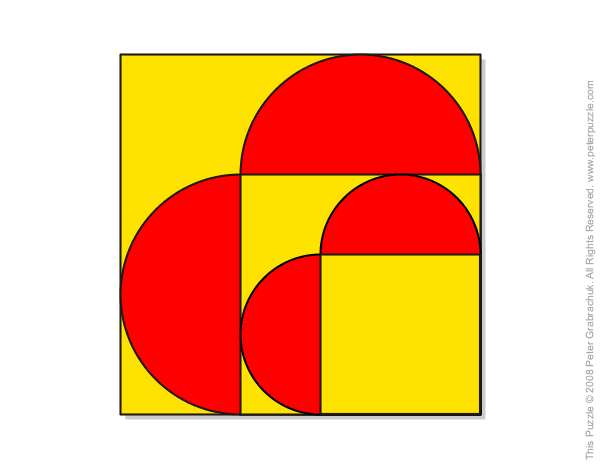
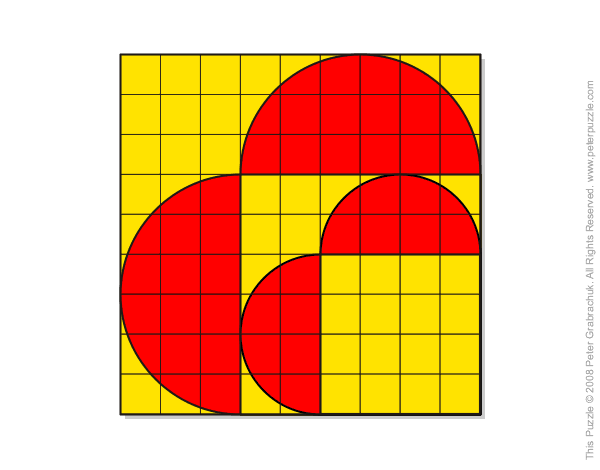
Double Hearts Ratio - Solution

Which area is bigger: the total orange or the total red?


The Solution . . .

Using the illustration below, we can calculate the following areas:

A(square) = 9 x 9 = 81;
A(red) = 28.27 + 12.57 = 40.84;
A(orange) = 81 - 40.84 = 40.16.
Thus, A(red) > A(orange).

Diophantus - Solution

We know very little about the life of the mathematician Diophantus (often known as the 'father of algebra') except that he came from Alexandria and he lived around the year 250 AD. 

However, there remains a riddle that describes the spans of Diophantus's life:

"This tomb hold Diophantus. Ah, what a marvel! And the tomb tells scientifically the measure of his life. God vouchsafed that he should be a boy for the sixth part of his life; when a twelfth was added, his cheeks acquired a beard; He kindled for him the light of marriage after a seventh, and in the fifth year after his marriage He granted him a son. Alas! late-begotten and miserable child, when he had reached the measure of half his father's life, the chill grave took him. After consoling his grief by this science of numbers for four years, he reached the end of his life."

In simpler English it says: Diophantus's youth lasted 1/6 of his life. He had the first beard in the next 1/12 of his life. At the end of the following 1/7 of his life Diophantus got married. Five years from then his son was born. His son lived exactly 1/2 of Diophantus's life. Diophantus died 4 years after the death of his son.

How long did Diophantus live?

The Solution . . .

There is an equation to reflect the several ages of Diophantus:

1/6x + 1/12x + 1/7x + 5 + 1/2x + 4 = x

So the solution (x) is 84 years.

Cut to the Average Puzzle - Solution

You have two straight lengths of wood. 

How can you cut one of them so that one of the three pieces is the average length of the other two.

Our Solution:

Put the two pieces end to end in a straight line:


Then the average length of the three cut pieces has to be one third of this total length.
So we simply cut one third of the way along the longer piece

Con Fusing - Solution

In front of you are several long fuses. You know they burn for exactly one hour after you light them at one end. The entire fuse does not necessarily burn at a constant speed. For example, it might take five minutes to burn through half the fuse and fifty-five minutes to burn the other half. 

With your lighter and using these fuses, how can you measure exactly three-quarters of an hour of time?

The Solution . . .

Fold one fuse and put another fuse next to it, light all three ends. When the fuse with both ends lit goes out, immediately light the other end of the lit fuse and lite a new fuse. When the second fuse goes out you will have three-quarters of an hour left burning on the third fuse.

Clock in the Mirror - Solution

Joey leaves his house in the morning to go to day camp. 

Just as he is leaving his house he looks at an analog clock reflected in the mirror. 

There are no numbers on the clock, so Joey makes an error in reading the time since it is a mirror image. Joey assumes there is something wrong with the clock and rides his bike to day camp. 

He gets there in 20 minutes and finds that just as he gets there the day camp clock has a time that is 2 1/2 hours (2 hours and 30 minutes) later than the time that he saw in the mirror image of his clock at home. 

What time was it when he got to day camp?

(The clock at camp and the clock at home were both set to the correct time.)

The Solution . . .

First subtract 20 minutes from 2 1/2 hours to compensate for his 20 minute bike ride to give a difference of 2 hours and 10 minutes.

To be a "Mirror Effect" it must be mirrored around 12 o'clock (when the hands are straight up), or around 6 o'clock (when the hands are pointing up and down), as we know he left in the morning, it must be 6 o'clock.

So, divide that 2 hours and 10 minutes by 2 and this will give you the center-point (65 minutes) for compensating for the mirror. 

By adding that 65 minutes to 6 o'clock you get the time he left home (7:05), and the time he saw in the mirror (4:55). 

Furthermore, by re-adding the 20 minutes from when he left (7:05), you get what time he got to camp (7:25).

Chain Reaction Puzzle - Solution

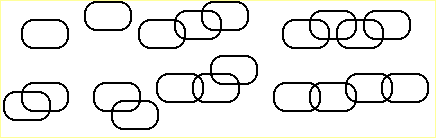
Chains. Make-up. What's the connection? The answer lies in a film. The DIY chain of shops, TEXAS, once made a film about their new eye make-up. They called it "The Texas Chain Store Mascara". I digress.

Below you can see several bits of broken chain. I have been told to join up all the pieces to make a complete necklace using all twenty links.


However, it is a very fiddly job, and it takes one minute to cut one link, and two minutes to join it up again. How long will it take me to finish the necklace?

Our Solution:

Just 15 minutes!! That's a surprise, isn't it? I'm sure you're on the very edge of your seat to know how it's done.

I'll tell you anyway.

Separate the two shortest lengths of chain by two cuts. This makes two open links and four single closed ones.
Time taken: 2 minutes. 
Cut open three of the single links. This leaves five open links and five pieces of chain (4, 4, 3, 3, 1).
Time taken: 3 minutes. 
Use the five open links to join the five pieces of chain (each link joins two ends).
Time taken: 10 minutes. 

TOTAL TIME: 15 MINUTES.

Broken Stick Puzzle - Solution

A 1-metre stick is broken into two pieces at random. What is the length of the shorter piece, on average?

Our Solution:

The shorter piece will be randomly from 0cm to 50cm long, with an average of 25cm

A Hole New Board Game Puzzle - Solution

How can I cut the board into only two pieces so that they will fill the hole exactly?


Our Solution:

Monday, 29 July 2013

Band around the Earth - Solution

The circumference of the Earth is approximately 40,000 kilometers, and someone has just made a metal band that circles the Earth, touching the ground at all locations.

You come along at night, as a practical joke, and add just 10 meters to its length (one hundredth of one kilometer !) 

It is now one four-millionth longer, and sits magically just above the ground at all locations

How far has it risen ... could a flea, a rabbit or even a man squeeze underneath it?

Our Solution:

Use the formula Circumference = 2 × pi × Radius

Before: Original Circumference = 2 × pi × R
After: Original Circumference + 10m = 2 × pi × (R + Gap)

Subtracting the two:

10m = 2 × pi × Gap

So, the Gap = 10m / (2 × pi) = 1.6m approximately

So a man could fit under it easily (though he might bump his head)


Note: Adding 10m to the circumference of ANY circle increases the radius by 10m / (2 × pi), no matter what the original circumference was.

Who Works Where Puzzle - Solution

Alex, Betty, Carol, Dan, Earl, Fay, George and Harry are eight employees of an organization 

They work in three departments: Personnel, Administration and Marketing with not more than three of them in any department.

Each of them has a different choice of sports from Football, Cricket, Volleyball, Badminton, Lawn Tennis, Basketball, Hockey and Table Tennis not necessarily in the same order.

Dan works in Administration and does not like either Football or Cricket.
Fay works in Personnel with only Alex who likes Table Tennis.
Earl and Harry do not work in the same department as Dan.
Carol likes Hockey and does not work in Marketing.
George does not work in Administration and does not like either Cricket or Badminton.
One of those who work in Administration likes Football.
The one who likes Volleyball works in Personnel.
None of those who work in Administration likes either Badminton or Lawn Tennis.
Harry does not like Cricket.

Who are the employees who work in the Administration Department?

In which Department does Earl work?

Our Solution:

Betty, Carol and Dan work in Administration department.

Earl works in the Marketing department.

Who Stole the Ginger Cookie from the Cookie Jar? Puzzle - Solution

There are five people - Holly, Cameron, Julieanne, Alex and Jackie.

Each one stole a special cookie of their favorite brand which was kept in a jar.
Each person ate it in a particular place and drank their flavored milk with it.

* Jackie is next to the person who eats on the lounge.
* Arnotts brand cookies are kept in a round jar.
* The person beside Cameron eats cookies at a table.
* The person who eats Oreos eats in the closet
* Julieanne likes Paradise brand cookies
* The person who drinks banana milk is in the middle and owns a tall jar
* The first person likes vanilla milk
* Holly is the person on the far right
* The person who eats in the bedroom drinks strawberry milk
* The person who owns the tall jar is next to the person who owns square jar
* Cameron drinks caramel milk
* The person who likes the Dick Smith brand is next to the person who likes the Coles brand
* The person who likes the No Frills brand is next to the person who owns a round jar
* The person who stole the 100s and 1000s cookies is next to the person who owns the brass jar
* The second person from the right eats No Frills brand and is next to the person who owns a round jar
* The first person on the left stole the choc chip cookies
* The person who eats Dick Smith brand is next to the person who eats Paradise brand
* The second from the left has a brass jar
* Julieanne is to the right of the person who drinks strawberry milk
* The person who drinks chocolate milk does it at the table
* The Paradise brand cookies are eaten in the kitchen
* The person who eats Tiny Teddies doesn't keep them in a round jar
* The Coles brand cookies are kept in a mini sized jar

A Ginger Cookie was also stolen. Who stole it?

Our Solution:

Holly did!

See below for full solution:

PersonAlexJackieJulieanneCameronHolly
FlavorVanillaStrawberryBananaCaramelChocolate
Cookie JarMiniBrassTallSquareRound
BrandColesDick SmithParadiseNo FrillsArnotts
CookieChoc chipTiny Teddies100s and 1000sOreosGinger
PlaceLoungeBedroomKitchenClosetTable

Saturday, 27 July 2013

Who Lives in the City? Puzzle - Solution

5 people are standing in a queue for plane tickets in Germany; each one has a name, an age, a favorite TV program, where they live, a hairstyle and a destination.

Names: Bob, Keeley, Rachael, Eilish and Amy 
TV programs: The Simpsons, Coronation Street ("Corrie"), Eastenders, Desperate Housewives and Neighbours.
Destinations: France, Australia, England, Africa and Italy
Ages: 14, 21, 46, 52 and 81
Hairstyle: Afro, long, straight, curly and bald
Where they live: A town, a city, a village, a farm and a youth hostel

1. The person in the middle watches Desperate Housewives
2. Bob is the first in the queue
3. The person who watches the Simpsons is next to the person who lives in a youth hostel
4. The person going to Africa is behind Rachael
5. The person who lives in a village is 52
6. The person who is going to Australia has straight hair 
7. The person travelling to Africa watches Desperate Housewives
8. The 14-year-old is at the end of the queue
9. Amy watches Eastenders
10. The person heading to Italy has long hair
11. Keeley lives in a village
12. The 46-year-old is bald
13. The fourth in the queue is going to England
14. The people who watch Desperate Housewives and Neighbours are standing next to each other
15. The person who watches Coronation Street stands next to the person with an afro
16. A person next to Rachael has an afro
17. The 21-year-old lives in a youth hostel
18. The person who watches Corrie has long hair
19. The 81-year-old lives on a farm
20. The person who is travelling to France lives in a town
21. Eilish is not next to the person with straight hair

Our Solution:


12345
NameBobRachaelEilishKeeleyAmy
Favorite TV
programme
The SimpsonsCoronation
Street
Desperate
Housewives
NeighboursEastenders
DestinationFranceItalyAfricaEnglandAustralia
Age4621815214
Where they liveTownYouth HostelFarmVillageCity
HairstyleBaldLongAfroCurlyStraight