Sunday, 11 August 2013

5 Pirates Puzzle - Solution


The Puzzle:

5 pirates of different ages have a treasure of 100 gold coins.

On their ship, they decide to split the coins using this scheme:

The oldest pirate proposes how to share the coins, and ALL pirates (including the oldest) vote for or against it.

If 50% or more of the pirates vote for it, then the coins will be shared that way. Otherwise, the pirate proposing the scheme will be thrown overboard, and the process is repeated with the pirates that remain.

As pirates tend to be a bloodthirsty bunch, if a pirate would get the same number of coins if he voted for or against a proposal, he will vote against so that the pirate who proposed the plan will be thrown overboard.

Assuming that all 5 pirates are intelligent, rational, greedy, and do not wish to die, (and are rather good at math for pirates) what will happen?


Our Solution:

The oldest pirate will propose a 98 : 0 : 1 : 0 : 1 split, in other words the oldest pirate gets 98 coins, the middle pirate gets 1 coin and the youngest gets 1 coin.

Let us name the pirates (from oldest to youngest): Alex, Billy, Colin, Duncan and Eddie.

Working backwards:

2 Pirates: Duncan splits the coins 100 : 0 (giving himself all the gold). His vote (50%) is enough to ensure the deal.

3 Pirates: Colin splits the coins 99 : 0 : 1. Eddie will accept this deal (getting just 1 coin), because he knows that if he rejects the deal there will be only two pirates left, and he gets nothing.

4 Pirates: Billy splits the coins 99 : 0 : 1 : 0. By the same reasoning as before, Duncan will support this deal. Billy would not waste a spare coin on Colin, because Colin knows that if he rejects the proposal, he will pocket 99 coins once Billy is thrown overboard. Billy would also not give a coin to Eddie, because Eddie knows that if he rejects the proposal, he will receive a coin from Colin in the next round anyway.

5 Pirates: Alex splits the coins 98 : 0 : 1 : 0 : 1. By offering a gold coin to Colin (who would otherwise get nothing) he is assured of a deal.

(Note: In the final deal Alex would not give a coin to Billy, who knows he can pocket 99 coins if he votes against Alex's proposal and Alex goes overboard. Likewise, Alex would not give a coin to Duncan, because Duncan knows that if he votes against the proposal, Alex will be voted overboard and Billy will propose to offer Duncan the same single coin as Alex. All else equal, Duncan would rather see Alex go overboard and collect his one coin from Billy.)

5 Pirates Version 2 Puzzle - Solution


The Puzzle:

5 pirates of different ages have a treasure of 100 gold coins.

On their ship, they decide to split the coins using this scheme:

The oldest pirate proposes how to share the coins, the OTHER pirates (not including the oldest) will vote for or against it.

If 50% or more of the pirates vote for it, then the coins will be shared that way. Otherwise, the pirate proposing the scheme will be thrown overboard, and the process is repeated with the pirates that remain.

Assuming that all 5 pirates are intelligent, rational, greedy, and do not wish to die, (and are rather good at math for pirates) what will happen?


Our Solution:

The oldest pirate will propose a 97 : 0 : 1 : 0 : 2 split.

Let us name the pirates (from oldest to youngest): Alex, Billy, Colin, Duncan and Eddie.

Working backwards:

2 Pirates: Duncan splits the coins 0: 100 (giving all to Eddie). Otherwise, and perhaps even then, Eddie would vote against him and over he goes!

3 Pirates: Colin splits the coins 99 : 1 : 0. Eddie is going to vote against him no matter what (see above) so gets nothing, but Duncan will vote for him, to get at least one gold out of it (if Duncan votes against him, there will only be two pirates remaining and Duncan will get nothing, and may even lose his life!)

4 Pirates: Billy splits the coins 97 : 0 : 2 : 1. This way, Eddie will vote for him, and so will Duncan - they're getting more than they would under 3 pirates.

5 Pirates: Alex splits the coins 97 : 0 : 1 : 0 : 2. This way, Eddie will vote for him, and so will Colin - they're both getting better than they would under 4 pirates.

A Perfect Match Puzzle - Solution


The Puzzle:

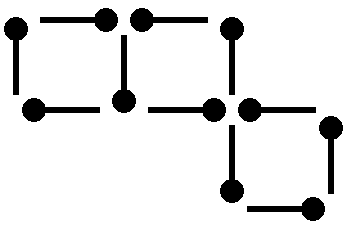
In this diagram 11 matches make 3 squares:


Your challenge is to move 3 matches to show 2 squares.

Our Solution:


Apples and Friends - Solution

The Puzzle: You have a basket containing ten apples. You have ten friends, who each desire an apple. You give each of your friends one apple.

After a few minutes each of your friends has one apple each, yet there is an apple remaining in the basket.

How?


The Solution . . .

You give an apple each to your first nine friends, and a basket with an apple to your tenth friend.

Each friend has an apple, and one of them has it in a basket.

Bags of Marbles - Solution

The Puzzle: 

You have three bags, each containing two marbles. Bag A contains two white marbles, Bag B contains two black marbles, and Bag C contains one white marble and one black marble.

You pick a random bag and take out one marble. 

It is a white marble.

What is the probability that the remaining marble from the same bag is also white?


The Solution . . .

2/3 (not 1/2)

You know that you do not have Bag B (two black marbles) so there are three possibilities

You chose Bag A, first white marble. The other marble will be white
You chose Bag A, second white marble. The other marble will be white
You chose Bag C, the white marble. The other marble will be black

So 2 out of 3 possibilities are white.

Why not 1/2? You are selecting marbles, not bags.

Black and White Hats - Solution

The Puzzle:
 Cannibals ambush a safari in the jungle and capture three men. The cannibals give the men a single chance to escape uneaten. 

The captives are lined up in order of height, and are tied to stakes. The man in the rear can see the backs of his two friends, the man in the middle can see the back the man in front, and the man in front cannot see anyone. The cannibals show the men five hats. Three of the hats are black and two of the hats are white. 

Blindfolds are then placed over each man's eyes and a hat is placed on each man's head. The two hats left over are hidden. The blindfolds are then removed and it is said to the men that if one of them can guess what color hat he is wearing they can all leave unharmed. 

The man in the rear who can see both of his friends' hats but not his own says, "I don't know". The middle man who can see the hat of the man in front, but not his own says, "I don't know". The front man who cannot see ANYBODY'S hat says "I know!" 

How did he know the color of his hat and what color was it?


The Solution . . .

The man in front knew he was wearing a black hat because he knew the first man did not see two white hats and he knew that the second man did not see one white hat because if he saw a white hat, the second man would have known that his hat was black from hearing the first man's statement.

Saturday, 3 August 2013

Measuring 4 and 4 Litres - Solution

You are camping, and have an 8-liter bowl which is full of fresh water.

You need to share this water fairly into exactly two portions (4 + 4 liters).

But you only have two empty bowls: a 5-liter and a 3-liter bowl. 

Divide the 8 liters in half in as short a time as possible.

The Solution . . .

Pour 5 liters from the 8-liter to the 5-liter bowl.

Pour 3 liters from the 5-liter to the 3-liter bowl, then pour those 3 liters back to the 8-liter bowl (the 8-liter bowl now has 6 liters).

Pour the remaining 2 liters from the 5-liter over to the 3-liter bowl, the bowls now contain 6, 0 and 2 liters each.

Now, pour 5 liters from the 8-liter to the 5-liter bowl (the 8-liter bowl now has 1 liter)

Pour from the 5-liter to the 3-liter bowl until it is full (exactly one liter). There should now be 4 liters left in the 5-liter bowl,

Pour the 3 liters from the 3-liter to the 8-liter bowl (and now the 8-liter bowl has 4 liters)

The 8-liter and 5-liter bowls now have 4 liters each, as required. And you will not be accused of bias by your fellow campers!

Measuring 2, 2 and 3 Liters - Solution

You have three bowls: 7, 4 and 3 liters in capacity. 

Only the 7-liter is full. 

Pour the fewest times to have the bowls containing 2, 2 and 3 liters.

The Solution . . .

Fill the 4-liter from the 7-liter bowl.
Fill the 3-liter from the 4-liter bowl.

You will have 3 liters left in the 7-liter,1 liter in the 4-liter and 3 in the 3-liter bowl. (Let us abbreviate that as 3,1,3)

Now pour from the 3-liter to the 7-liter bowl, and then pour the 1 liter left in the 4-liter bowl to the 3-liter bowl. (Now it looks like 6,0,1)

Now fill the 4 from the 7 (Now it looks like 2,4,1) 
Now fill the 3 from the 4 (Now it looks like 2,2,3) 

And you are done: 2, 2 and 3 liters !

Measuring 2 Litres - Solution

Measure exactly 2 liters of water if you have:

1) 4 and 5-liter bowls
2) 4 and 3-liter bowls

The Solution . . .

1) Fill the 5-liter bowl, pour water from it to fill the 4-liter bowl, which you empty afterwards. 

Pour the remaining 1 liter to the 4-liter bowl. 

Refill the 5-liter bowl and then carefeully pour water from it to fill the 4-liter bowl (where there is already 1 liter). This will only need 3 liters.

Thus you are left with 2 liters in the 5-liter bowl, as requested.

2) The same principle - this time from the other end. Fill the 3-liter bowl and pour all of the water to the 4-liter bowl. 

Refill the 3-liter bowl and fill the 4-liter bowl to the top. 

And then you have 2 liters left in the 3-liter bowl.

Making the Average Puzzle - Solution

If I drive half-way to the city at 30 km/hour, how fast do I have to go for the rest of the way to make the average speed for the entire journey of 60 km/hour?

Our Solution:

You should be there already! 

You are half way there, and want to double your average, so your speed would have to be infinite.


Example: Let's say it is 120 km to the city
You get halfway (60 km) at 30 km/h, which takes 2 hours.
To make it all the way (120 km) at 60 km/h would take 2 hours ... but you have already been driving for 2 hours, so your time is up.